


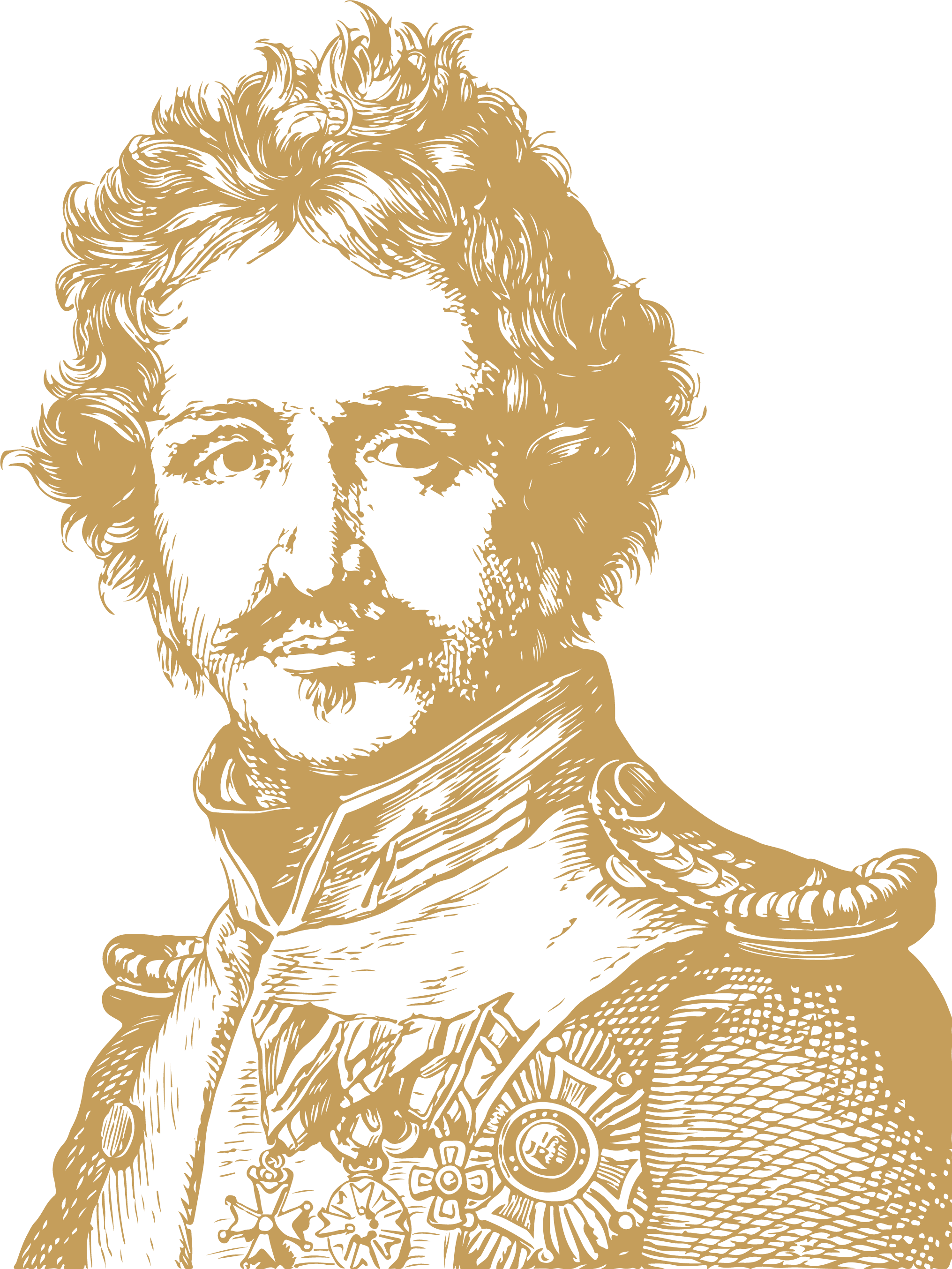


Our healing water has attracted celebrities from all over the world for centuries.
King Ludwig I, Empress Elisabeth of Austria and Tsarina Katharina all tasted the tasty water, which is also called champagne because of its natural carbonic acid content.
Famous Guests
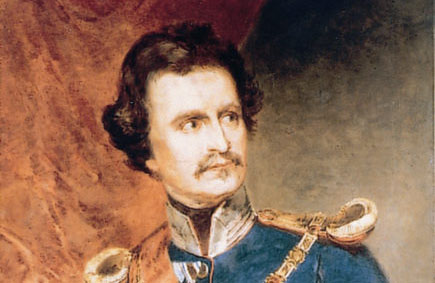
King Ludwig I 1786-1868
Romantic politician. Crown Prince Ludwig was born on August 25, 1786 in Strasbourg. His parents are Maximilian I Joseph King of Bavaria and Auguste Wilhelmine of Hesse-Darmstadt. In 1810, Ludwig married Therese of Saxe- Hildburghausen. Ludwig spent his crown prince years from 1816-1825 in Aschaffenburg and Würzburg before he was named King Ludwig I of Bavaria in the month of his father’s death. Just one day after taking his royal oath, King Ludwig I ordered that the name “Bavaria” should be written with a y in the future.
In 1818, while still crown prince, he visited Bad Brückenau for the first time. Inspired by the peace and quiet, the untouched nature in contrast to the turbulent Munich Residence, 25 further stays followed, which had a decisive influence on Bad Brückenau. He completed the baroque complex of the Staatsbad, had the springs refilled and, from today’s perspective, was an early ecologist who was concerned with the special protection of nature in the Sinntal. It is thanks to his commitment in the areas of educational policy, culture and churches that 75 new monasteries were founded between 1826 and 1848, as well as the establishment of universities and central schools. In 1835, on Ludwig’s initiative, the new coat of arms for Bavaria was adopted, symbolizing all the tribes in Bavaria (Old and Lower Bavaria, Palatinate, Franconia, Swabia). In 1846, the 25-year-old dancer Elizabeth Gilbert alias Lola Montez arrived in Munich, met the king and became the 60-year-old’s mistress. In 1847, Lola Montez and Ludwig, who had now been ennobled as Countess Landsfeld, spent a stay together in the anonymity of Bad Brückenau. Numerous poems about her and letters to Lola Montez today demonstrate the king’s deep affection. In 1848, armed students and civil unrest throughout Bavaria led to the king’s abdication. His eldest son Maximilian II becomes his successor. Queen Therese died in 1854, King Ludwig died on February 29, 1868 in Nice.
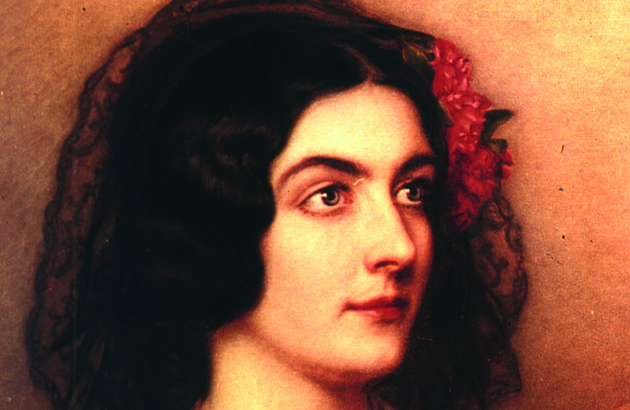
King Ludwig I’s mistress Elizabeth Rosanna Gilbert (Lola Montez) was born on February 17, 1821 in the Irish village of Grange near Sligo. Her parents are the English officer Edward Gilbert and Eliza Oliver, who comes from Irish rural nobility. In 1823 Edward Gilbert and his young family were transferred to Calcutta in the British colonial empire. Elizabeth grew up in India, England and Scotland. In 1837 she married the officer Thomas James. The marriage ends in divorce and Elizabeth Gilbert returns to England.
Elizabeth Gilbert becomes Lola Montez. In June 1843 she appeared in London for the first time as a solo dancer from Seville. The change of identity is seen through by the audience. The dancer leaves England and moves across the continent. She makes guest appearances in St. Petersburg, Warsaw, Berlin, Dresden and Paris. After her performances, which are always accompanied by scandals and affairs, she is usually expelled from the cities. A sensational trial occurs in France after her lover is shot in a duel.
Her stay in Bad Brückenau in 1847 was the highlight of her biography. Ludwig I, King of Bavaria, names his lover Lola Montez Countess of Landsfeld. It became the catalytic trigger of the 1948 revolution in Munich. In February 1851 Lola Montez reached New York. She died on January 17, 1861, shortly before her 40th birthday in New York and is buried in the cemetery in Brooklyn.
A special physicist. Melchior Adam Weikard was appointed physicist for the Brückenau office in 1764 and thus became a spa doctor at the Staatsbad. Born in Römershag, a district of Bad Brückenau, as the son of a local innkeeper, the house where he was born is still preserved as an inn today.
Weikard wrote several fountains and invitations “to the cure in Bad Brückenau”. He made the young spa town famous far beyond German borders. In 1784 he was appointed court physician to the Russian Tsarina Catherine II at the tsar’s court in St. Petersburg. Weikard returned to Bad Brückenau and died there in July 1803.
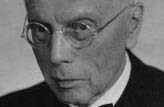
The urologist who made Bad Brückenau world famous. The appointment of Dr. Felix Schlagintweit, an internationally recognized authority in the field of urology, becoming a spa doctor was a stroke of luck for Bad Brückenau. His specialist books and specialist magazines, which were read and followed all over the world, helped Bad Brückenau gain worldwide fame as a spa for kidney and bladder diseases. While Schlagintweit practiced in Bad Brückenau, kings and emperors visited the place. One of his most famous patients was Empress Elisabeth of Austria, who spent a four-week treatment in Bad Brückenau in 1898. Dr. Felix Schlagintweit died in 1950. Before her death in 1959, his widow bequeathed part of her assets to the Free State of Bavaria.
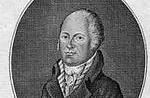
An outstanding doctor and courageous designer. The son of a citizen of Bad Brückenau had studied in Fulda and Heidelberg and with great commitment succeeded his great predecessor Melchior Adam Weikards as a spa doctor in Bad Brückenau. Zwierlein caused a great stir with his idea of introducing new women’s fashion specifically for the cure. As a bath doctor, he wanted simpler clothing than was the case at the time – a bath uniform.
For this purpose he called a women’s congress in Bad Brückenau in 1792. In fact, the bathroom uniform designed at the time was not verifiably produced. Today a replica model can be seen in the Bad Brückenau city museum.
Magnificent architecture
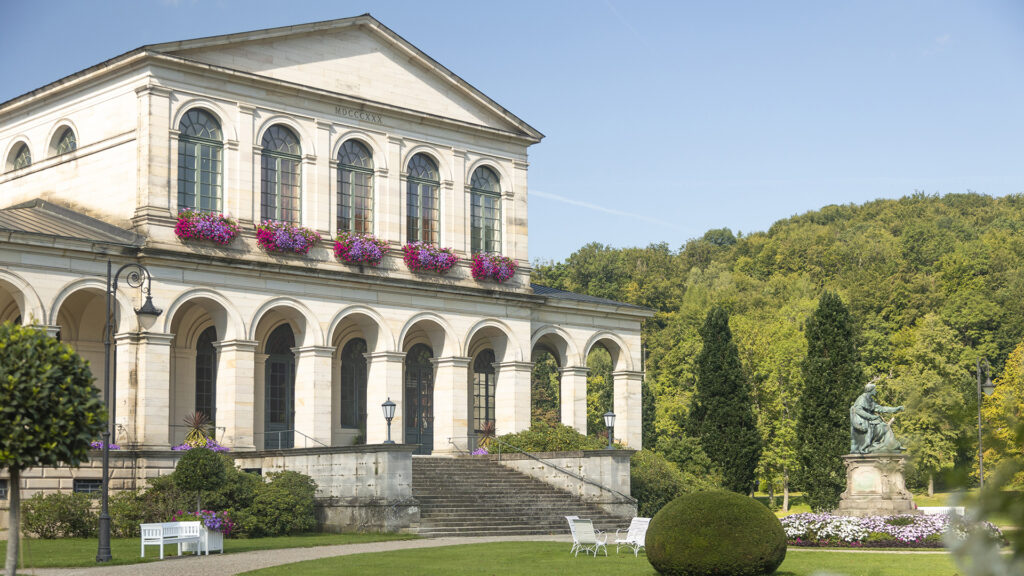
In 1827–1833 the monumental Spa Hall building was built according to the plans of Johann Gottfried Gutensohn next to the Spa Hotel on the west side of the spa garden. In 1826 King Ludwig I. invited architects to a competition for a construction programme which was created by himself. In the tradition of Italian Renaissance buildings there arose a construction in white sandstone with impressive dimensions of 20 metres height, 40 metres width and a length of 60 metres. The two-floored Spa Hall building with a basilica-like cross-section arises on a powerful, three metre high, square substructure. On the narrow sides broad perrons lead to the superstructure where an outwards-opening covered walkway (“Wandelgang”) with round arched pillar arcades has been laid out. The five-axis central block projects a little bit above the facades and is aligned over the upper floor structured with five round arched windows and a triangular pediment.
Inside an anteroom leads to the central, square, two-floored Spa Hall. This exclusive scene is a stage for concerts, galas, meetings and weddings. On both sides round arched pillar arcades open to domed ancillary rooms. Behind the main hall, the King Ludwig I. Hall is the Lola Montez Hall, which is used for theatre events. In the upper floor, above the anteroom, is the Royal Box, which has a connection to the main hall through big round arched windows. The painting by the Munich painters Ludwig Höger and Jakob Hochbrand emphasizes the festive effect of the building with Italian renaissance ornaments made accoroding to plans by Gottfried Gutensohn.
Today, dances and galas, balls, concerts, theatre performances and lectures
take place here. During conferences and weddings, the royal atmosphere underlines
the festive flair.
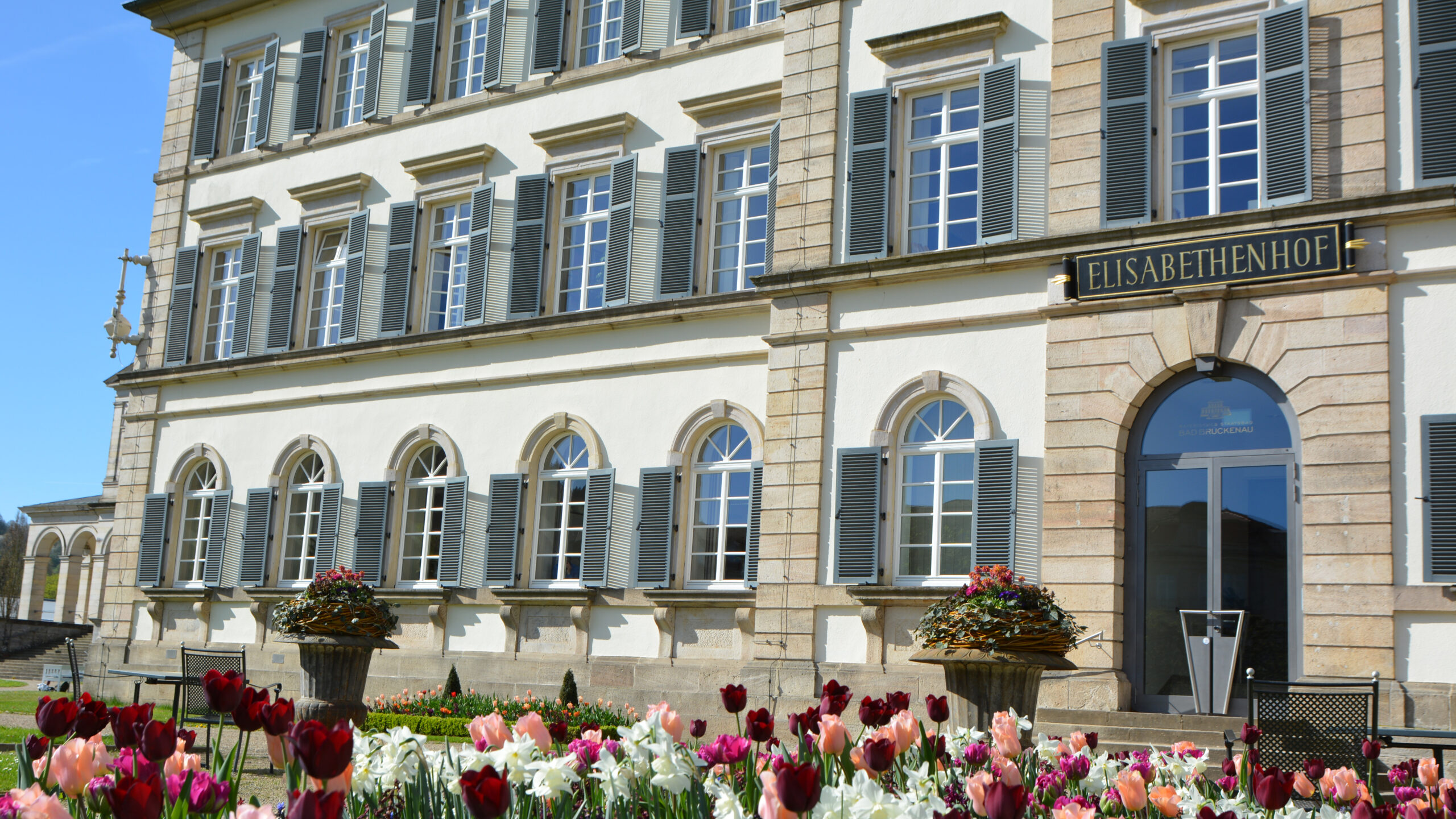
In 1894, as a counterpart to Badhotel Klenzes, a guest house with 48 rooms was built in the classicist style. The building was named after Empress Elisabeth of Austria (Sisi), who lived here for four weeks in 1898. The spa doctor Felix von Schlagintweit had his urological surgery here, and Empress Elisabeth as well as the high aristocracy were among his patients. Today the
building encompasses the offices of the Staatliche Kurverwaltung (State Spa Administration) with guest information desk (advance booking, sale of hiking maps, souvenirs, reservations for tours round the State Spa), the guest lounge (internet, newspaper selection) as well as doctors and a center of excellence and an apartment.
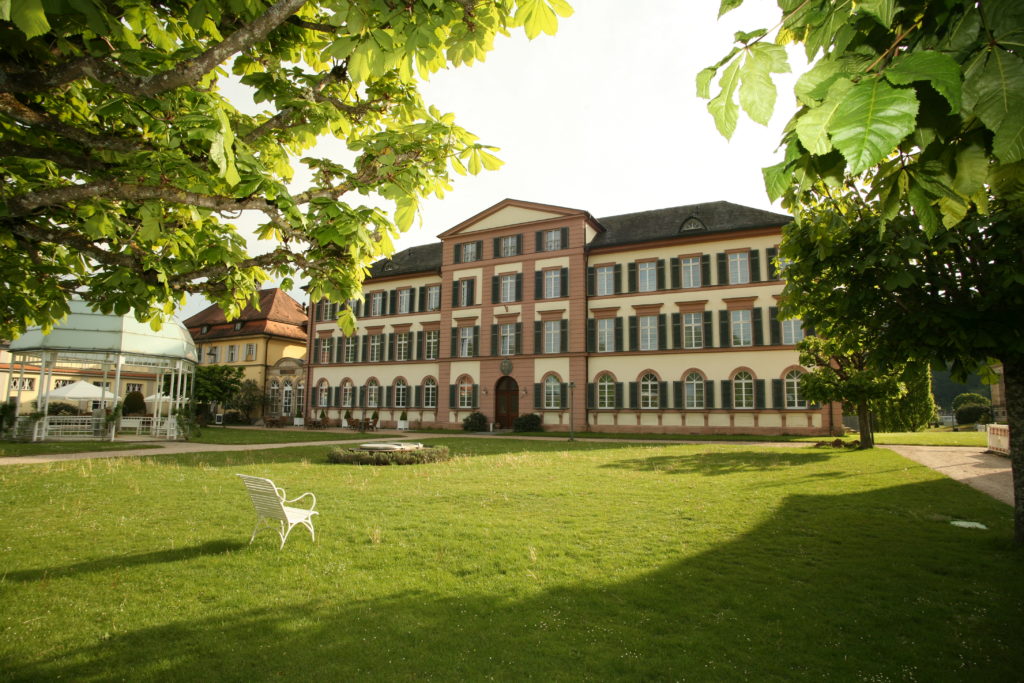
In 1821–1823, in place of the outdated bath house of 1779, a large new building was built by order of King Ludwig I. according to the plans of Leo von Klenze and under the control of the Würzburg district architect Dreyschütz.
The 13-axis, three-floored facade extends over a length of 42 metres at the park. A risalit with a triangular pediment ephasizes the three central axes. Window forms and fascias that change floor by floor give the building a definite structure following Klenze’s Munich palace buildings. The bathing cabins were located on the ground floor and the guest rooms in the upper floor. In 1846, after the introduction of mud baths, the bath building receives an outbuilding with 12 mud bath cabins. In 1883 the bathing rooms – a first spa house in today‘s state spa. In 1910–1911 the bath house wing is created according to the plans of court architect Eugen Drollinger. Today the Badhotel has a total of 30 rooms. Its restaurant “Altes Badehaus” will spoil you with Franconian and international cuisine, the beer garden and café will invite you to sit down and relax.
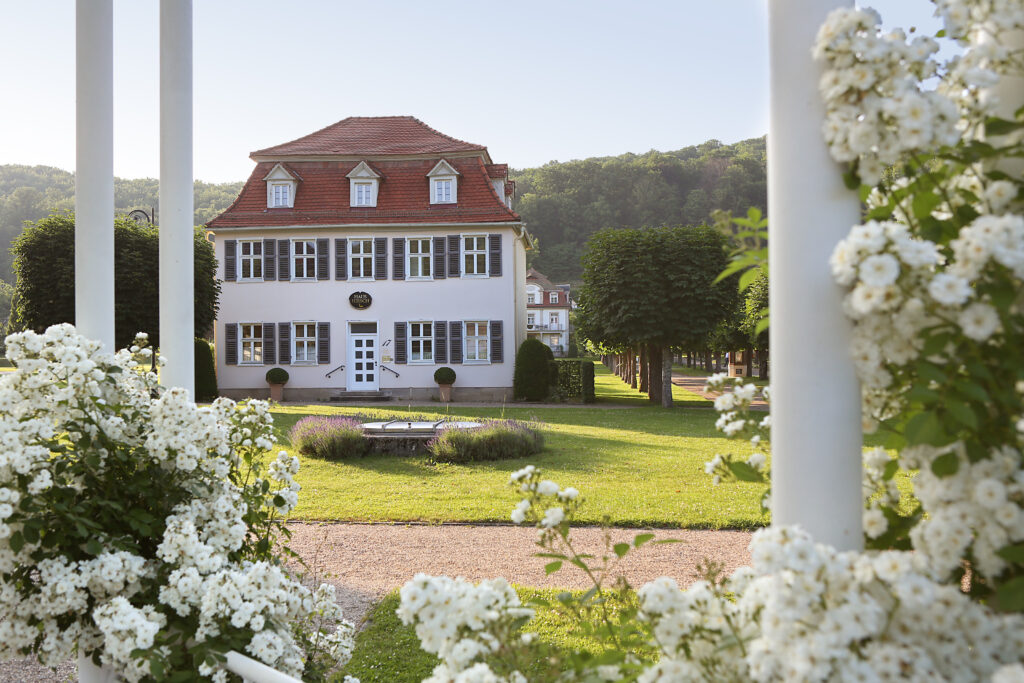
In 1747, in the Fulda era, the year the spa was founded, the baroque pavilionwas built with a mansard roof. Even today, the Deer House is the only building of five others (Beaver, Lamb, Lion, Ram and Swan) by the architect and building inspector Andreas Gallasini that is still preserved in its original location.
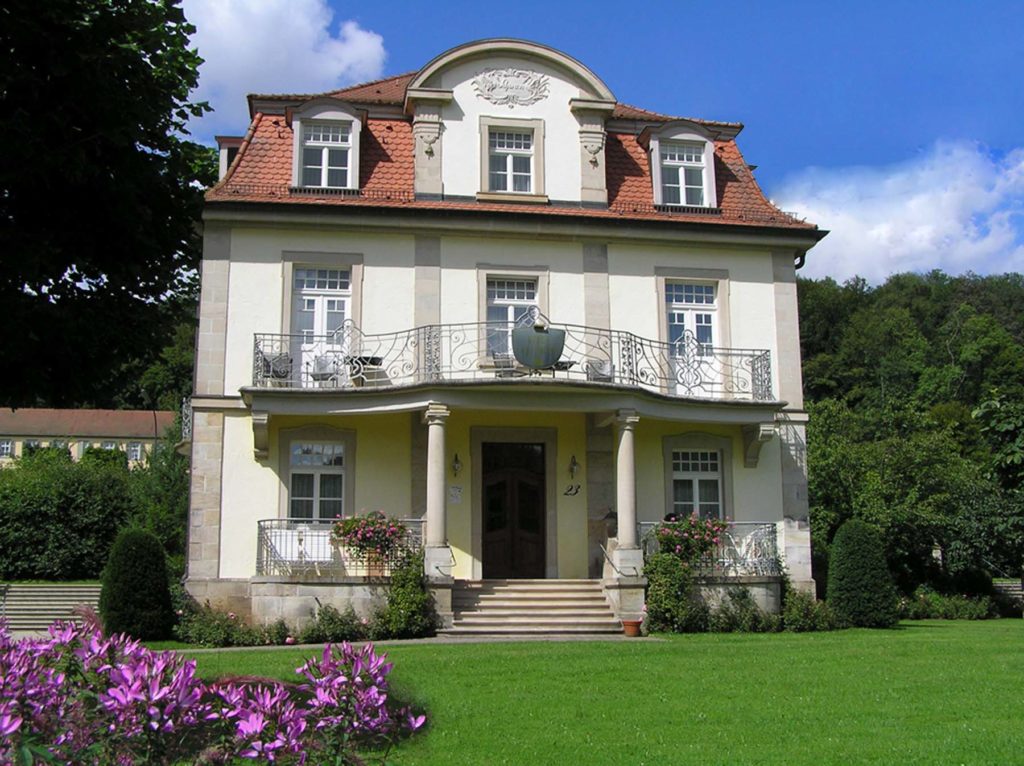
Built according to the plans of the Munich architect Eugen Drollinger in the Art Nouveau style in 1906, the Swan Villa is nowadays a modern, comfortable accommodation facility in central location in the historical spa gardens.
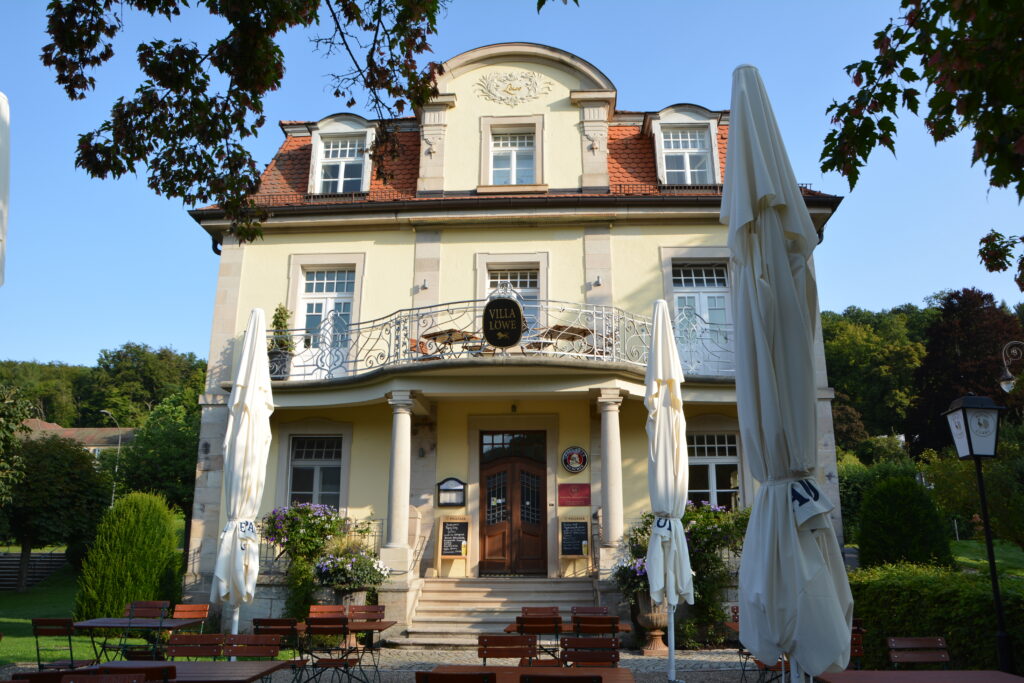
Built in 1907 as an Art Nouveau villa. Lola Montez, the mistress of King Ludwig I, is said to have lived in the original building for eight weeks in 1847.
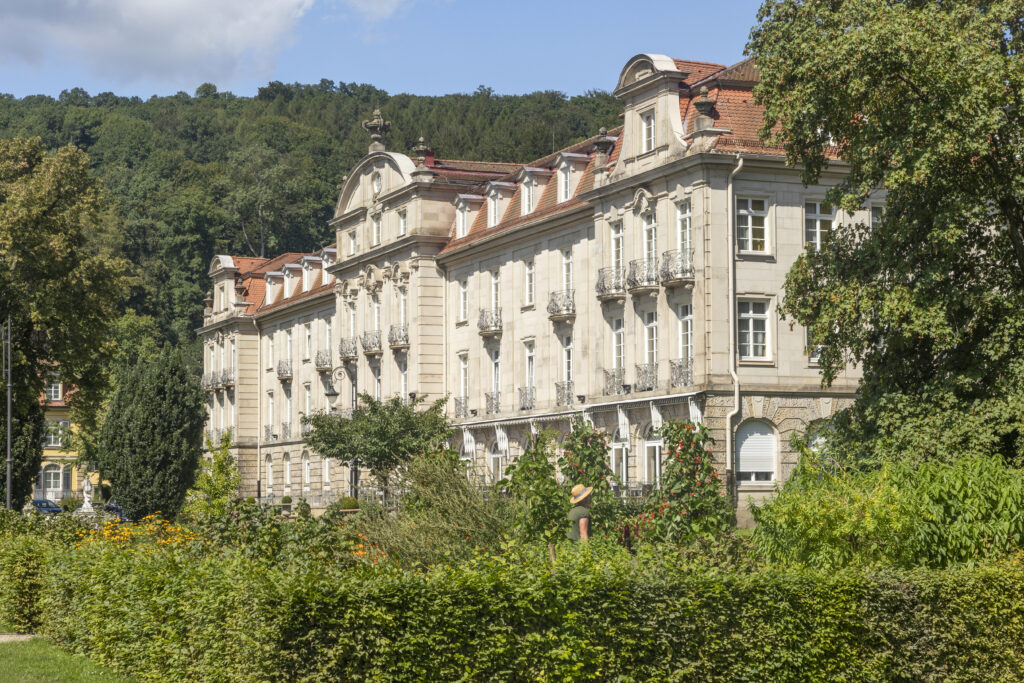
In 1899–1901, a guest house was built opposite the “Kursaal” building according to the plans of the Munich architect Max Littmann. The enormous, threestorey structure with a façade length of 19 axes was formed in the tradition of the Art Nouveau. The façade facing the Castle Park is structured by a raised, three-axis, projecting corner construction. High mansard roofs, window frames, balconies and other decorative building sculptures simulate baroque forms. In 1949, Konrad Adenauer met with the “Ellwangen Circle” in that time spa hotel and laid down the name “Federal Republic of Germany”. The hotel with his gardenwing has been refurbished several times and is a four-star superior hotel. The “Vital Spa & Garden” is considered more exclusive wellness area with physiotherapy facilities on an area of 2,800 square metres.

The former long building was replaced in 1901 by a partlycovered promanade, the so called “Wandelhalle”, a light, elegant iron construction with a domed roof in the centre. In 1911 the existing hall was expanded up to Wernarz mineral spring by Eugen Drollinger. The inauguration of the fullycovered Wandelhalle, planned by architect W.F. Kunze, took place in 1950.
Today the Wandelhalle is a meeting point for our guests. With a day, guest an annual spring pass from the State Spa you can enjoy free of charge the medicinal water in the lounge. The cleansing Wernarz spring, the King Ludwig I. spring: the stabilizing one, the invigorating Sinnberger spring, the revitalizing vital spring, the Lola Montez spring: the beauty spring.
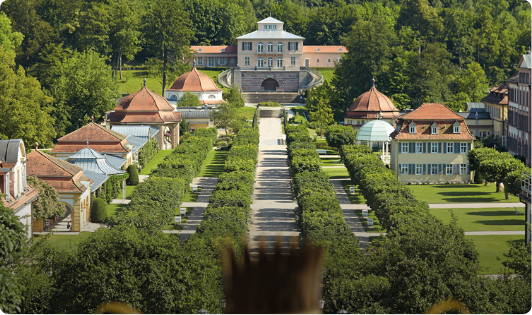
In 1818–1819, the privy architect Bernhard Morelli built a guest house on the southern rise of the central axis, on the same level but opposite, the Fürstenbau (Prince´s Residence), as the finishing touch to the entire park. The main facade facing the Castele Park, with its classicist forms, is dominated by an elevated basement level with high vaulted basement rooms.
On both sides oft he basement entrance, curved outside staircases lead to the main two-storey building, which is set back on a panorama terrace and which is adjoined by single-storey wings with open arcades. In the ground floor, the Castello Belvedere invites connoisseurs to enjoy italian specialities. The vaulted basement was used as a food storage facility right up until the 1930s.
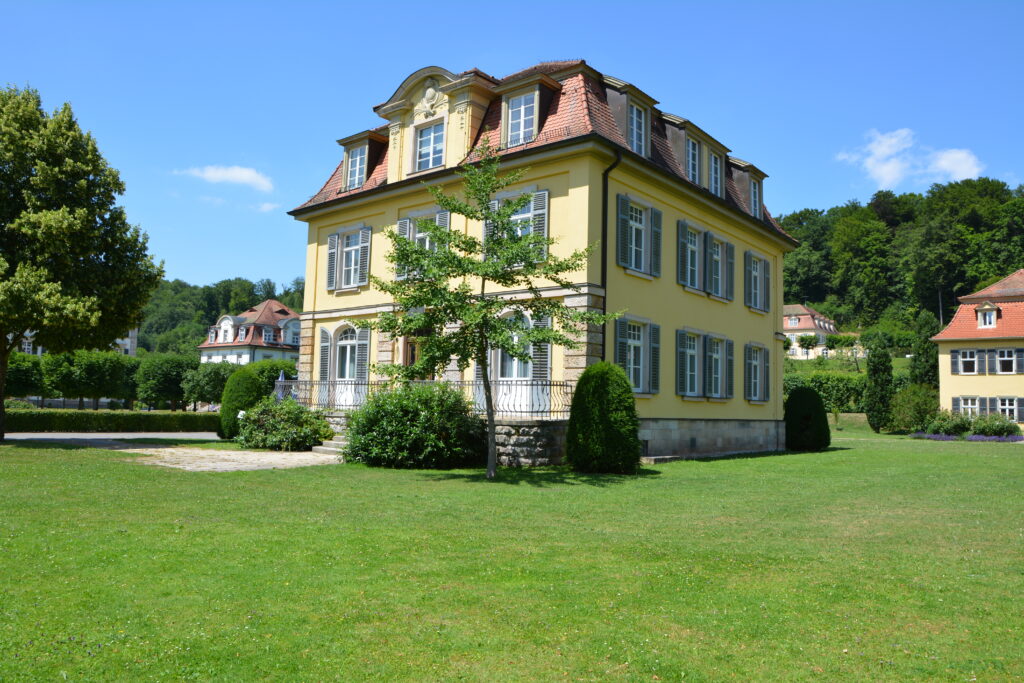
The building was constructed in 1901 in the Art Nouveau villa style to replace the half-timbered building of the same name located in the centre of the castle park. The original Widder house was one of six identical baroque pavilions named Biber, Hirsch, Lamm, Löwe and Schwan, which were built as guest houses in 1747, the year the spa was founded. Today, Villa Widder is a holiday and spa residence with a special flair in the middle of the castle park.
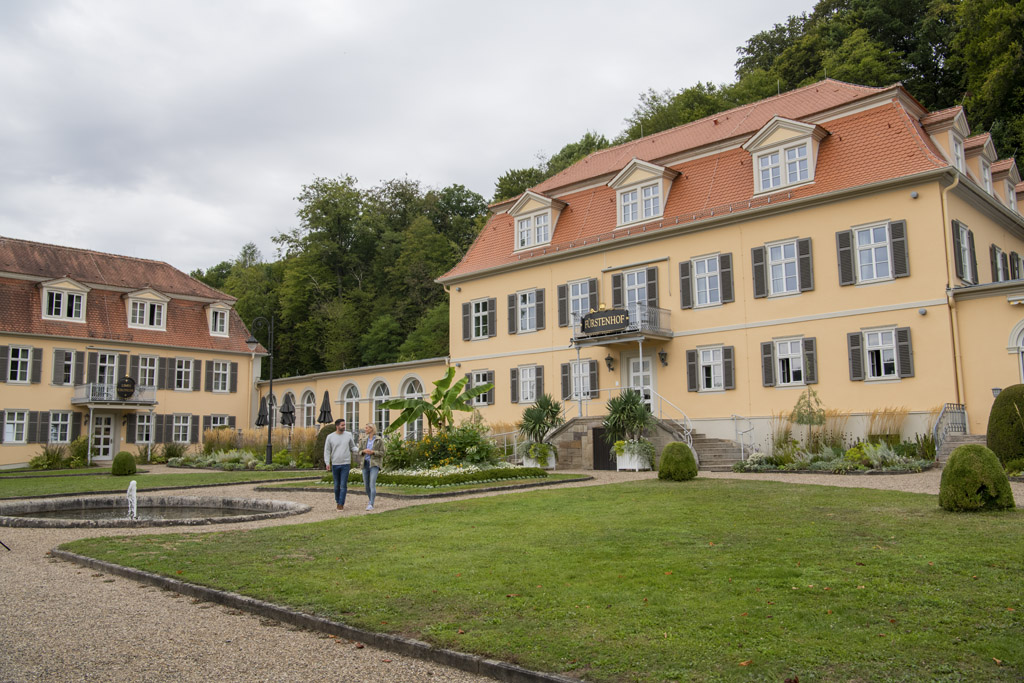
In 1751 the two-floored inn ”Ross” (Steed) was created as the main building. In front of the building the hillside slopes in terraces into the valley, where the axis of the main boulevard continues. As a guest house with hall, stalls and depot it was the cultural centre of the town. In 1775 the site was extended to become a baronial summer resistance on behalf of Prince-Bishop Heinrich von Bibra. It is now called ”Fürstenhof”. The complex of buildings with its clearly structured and high mansard hipped roofs had been used as the residence of Bavarian crown prince and later King Ludwig I. of Bavaria
since 1818 during his 26 stays in Bad Brückenau. With the accession to the throne of Ludwig I. the holding of court was increased; Johann Gottfried von Gutensohn (1792–1851) carried out the conversion of the stables into a cavalier building with living quarters and inns in 1823, taking account of the baroque appearance. In 1873 the buildings are transferred to the estate of Queen Amalie of Greece. After 1875 they were privately owned; in 1924 repurchase and furnishing of the Palace Hotel. In 1978–1980 and 2002 a fundamental renovation took place, a general renovation in 2019.
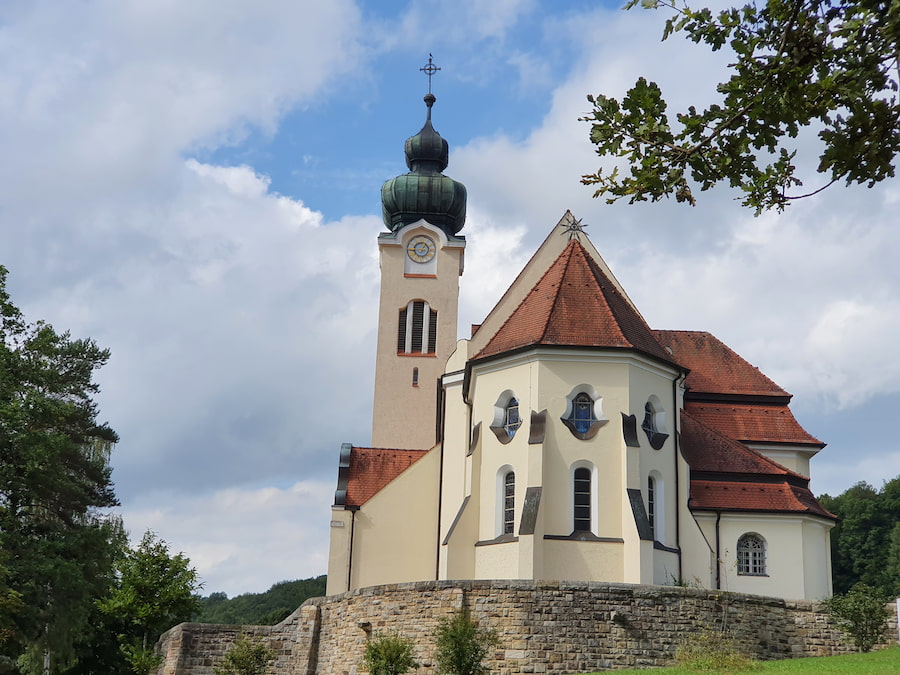
The church is adapted from the old Bavarian baroque churches. It was built according to the draft by Eugen Drollinger and consecrated in 1908. The red sandstone floor has a herringbone patern. The way of the cross and the statue of the Virgin Mary were created by the Brückenau artist Sebastian Putz.
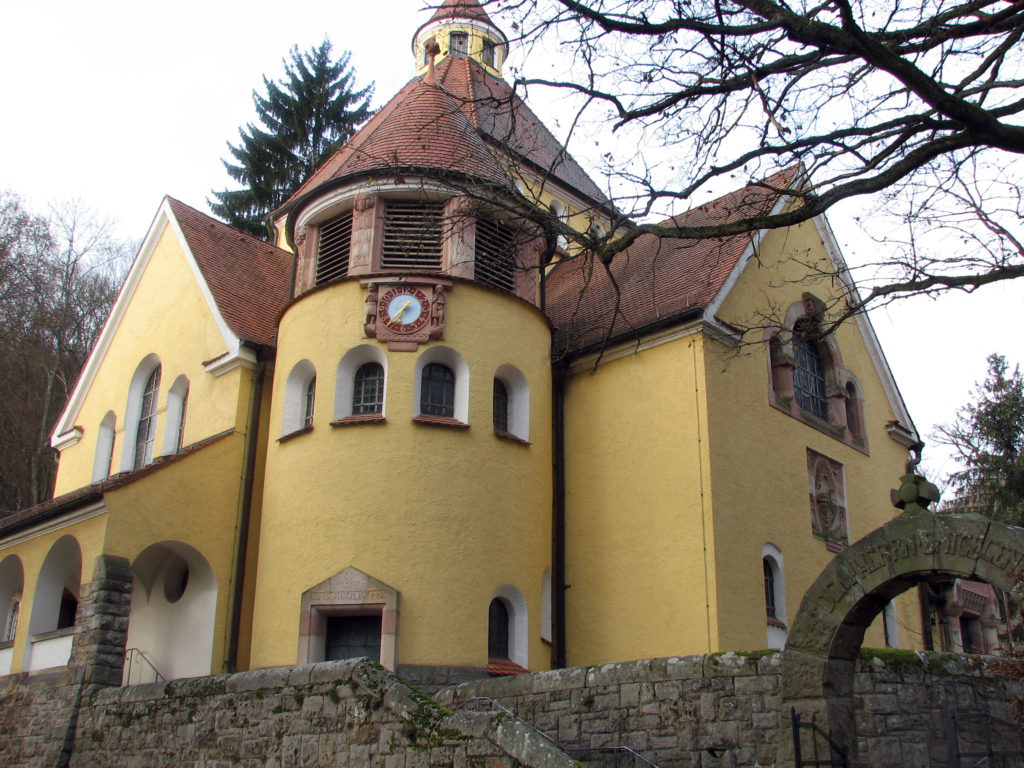
The church is built in the Art Nouveau style according to the plans of the Munich court architect Eugen Drollinger. It was consecrated in 1908 and is unique in Lower Franconia. In architecture and equipment, the church is adapted from the Church of the Holy Sepulchre in Jerusalem. The white sandstone used is from a quarry in nearby Fondberg.
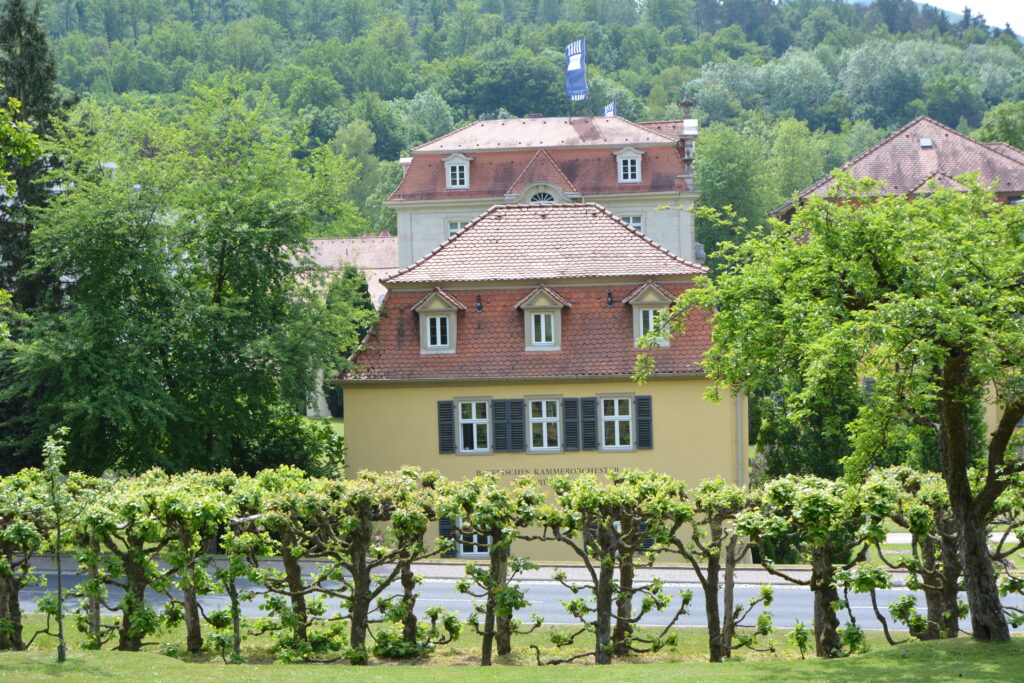
Baroque pavilion built in 1747 and later relocated. Today home to the Bavarian Chamber Orchestra Bad Brückenau.
Do you have questions and are you planning a visit with us?
We would be happy to provide you with more detailed information. Don't hesitate to contact us.